
Realists and Liberal Values
Realism is not a rejection of moral and legal principles, but merely a caution against raising them above the hard limits of power and survival

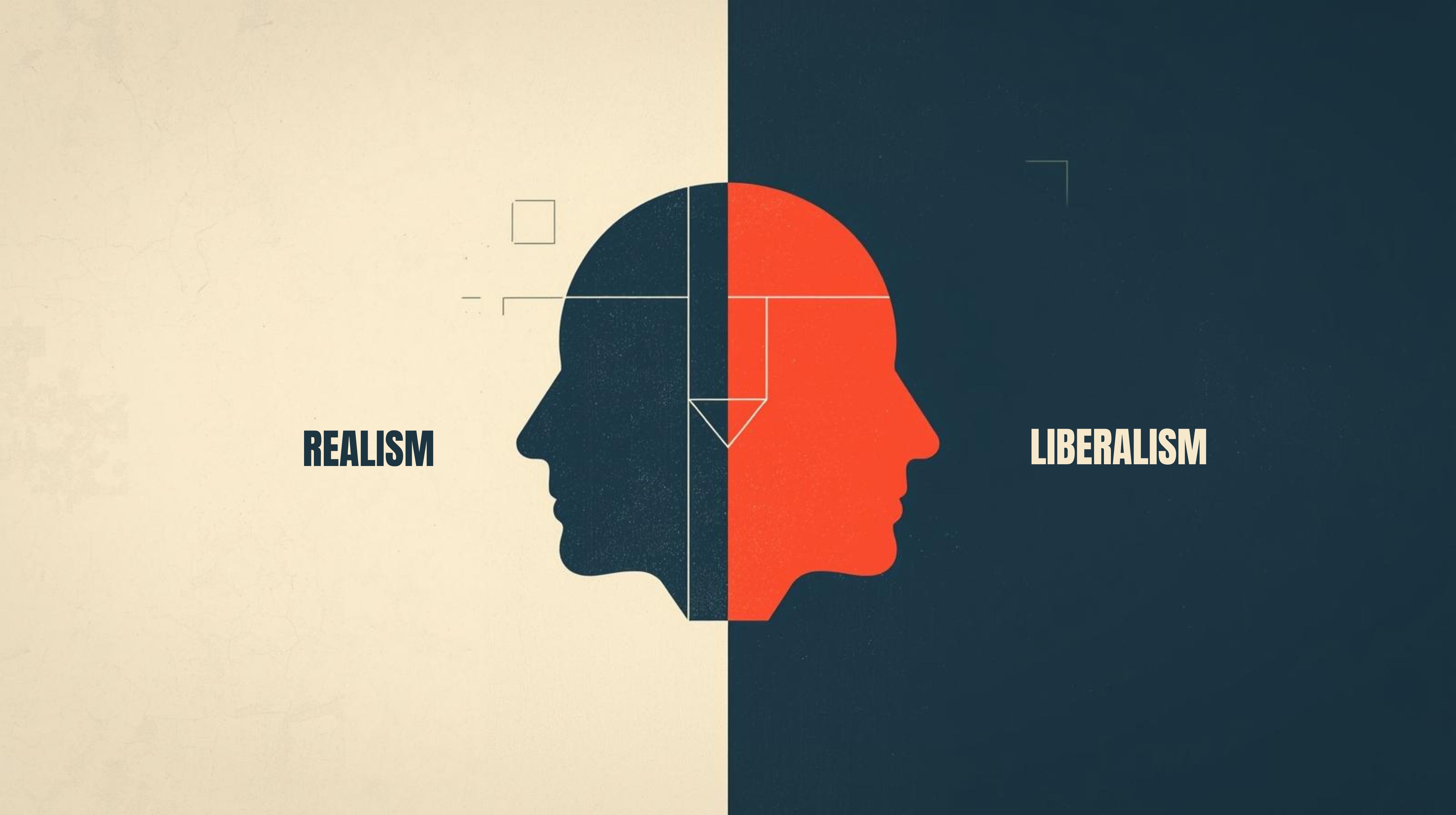
Realism and liberal principles have frequently been at odds. While liberalism values democracy, rights, law, and trade, realism stresses the role of survival, security and power in international politics. The realists scepticism does not entail a downgrading of such values; it confines them to their role as dependent upon insecurity and competition, whuch are central to the realist tradition. This essay examines how realists navigate liberal ideals, acknowledging their value but subordinating them to security, order, and caution.
Realists do not reject democracy, the rule of law, human rights, or a free trading order, but they interpret these concepts in a way that is incompatible with liberal thought. The “realist” worldview has, at its base, the belief that the international system is anarchic. No overarching world power exists to enforce rules, resolve conflicts, or keep the peace. States are still the leading actors in the international system, and survival is the most essential aim of their foreign policy. Hans Morgenthau believed international politics is subject to objective laws rooted in human nature, the most fundamental being the power struggle. Kenneth Waltz later argued that in an anarchic system, the structure of capabilities forces states to behave more or less similarly regardless of regime type or ideology. It is this theoretical base that accounts for realism as an outlook that values power, security, and prudence above the search for universal moral objectives.
From this perspective, realists are sceptical about the extent to which democracy as a domestic system of government affects state behaviour in the international arena. It is not that realists are fundamentally against democracy; many realists have admired democracies, but democratic regimes must wage wars and seek power like autocracies when vital interests are at risk. Morgenthau had cautioned that a “crusading spirit” in foreign policy, fuelled by moral passion, typically ends in catastrophe because it refuses to recognize the tragic constraints imposed by politics. As the prime defender of offensive realism, John Mearsheimer has been a particularly vociferous opponent of attempts to export democracy through force of arms, such as in American wars against Iraq and Afghanistan. He contends that such liberal fetishes have the opposite effect: They destabilize regions, weaken the great powers, and invite strategic blowback — all in the service of greater rather than lesser insecurity.
For human rights, the same logic applies. Realists do not simply reject the moral attractiveness of human rights norms. They view them as fragile benefits, achievable only if they do not threaten state survival. From their perspective, human rights activists are hypocritical, and the promotion of human rights is a form of real politics: principles when we defend them (the weak), partisan ones in terms of how we implement such ideas (through or by strong states). Moreover, when push comes to shove, realists predict that states will compromise human rights concerns for the sake of raison d’état. The U.S. partnership with authoritarian regimes in the Middle East, no matter how abysmal their rights record, is an example of that. For realists, this is not hypocrisy at all — it is simply the expected result of security taking precedence.
International law and institutions are expectedly viewed with suspicion. Realists accept that law, treaties, and institutions can help promote cooperation by conveying information, lowering transaction costs, and constructing common expectations. However, they argue that those mechanisms only work if the interests of powerful countries converge with those of the mechanism. Waltz claimed international institutions are “epiphenomenal” in the sense that they are a reflection rather than a binding constraint on the distribution of power. When the rules are inconvenient, great powers disregard them or rationalize around them: think of how NATO ignored the UN Security Council during its intervention in Kosovo, or America’s pulling out of the Paris Climate Agreement. To realists, the so-called international “rule of law” is not backed up by any sovereign who will come and enforce it but depends ultimately on state volition.
Moreover, even the liberal defense of a free-trading order is handled instrumentally by realists. Trade is accepted if it benefits the nation, boosting its military, but economic openness is not a moral imperative. Realists approve of protectionism, financial coercion, or even decoupling if these measures are needed to maintain strategic autonomy or undermine an adversary. The modern-day discussion about supply-chain security, semiconductor export controls, and weaponized interdependence reaffirms the realists’ intuitive understanding: There can be no such thing as economic policy insulated from concerns of power politics.
However, realism is not a monolith, and to suggest that it is would be misleading. In recent decades, a so-called “subaltern realist” literature has come of age, which attempts to theorise states’ security predicaments within the South. Subaltern realism has a somewhat different view of democracy, human rights, and the rule of law. While it has mainstream realism’s scepticism of liberal internationalism, it is more alert to the internal weaknesses of weak states. Ayoob argues that external pressures to democratize or liberalize too quickly can actually contribute to instability in fragile polities and result in state failure or prolonged contention. For subaltern realists, the pressing moral duty is ordering within states, what Bull would refer to as the ‘elementary goals of social life.’ Democracy and rights are good, but they need to be timed and adjusted to meet the demands of state-building. Such an idea echoes the arguments of scholars like Fareed Zakaria, who have cautioned against “illiberal democracy” where institutions are frail.
On international law and economic openness, subaltern realists are typically more skeptical than their Western counterparts, in part because they see the so-called liberal order as normatively skewed toward the strong. Many of the rules governing trade, investment, and intellectual property were instruments to keep developing countries in subservient roles in the global economy. Therefore, demands for a “rule-based order” are sometimes seen in the Global South as ploys to ensure the uninterrupted sustenance of Western dominance. Subaltern realism, for its part, is critical of universalist claims and seeks to promote a more pluralist, negotiated and just world order.
Taken as a whole, such reflections contribute to the realist literature. They serve to remind us that realism is not a rejection of moral and legal principles, but merely a caution against raising them above the hard limits of power and survival. Democracy, human rights, the rule of law, and free trade are noble callings, but they are only possible in a condition of security and order. Mainstream realists emphasize prudence, balance, and restraint, cautioning against ideologically mobilized attempts to remake the world in its own image. Subaltern realists extend this caution by arguing that the promotion of liberal values should acknowledge the historical and structural handicaps faced by weaker states. Both strands coalesce here, holding that a stable (albeit imperfect) order is the condition of possibility for every normative agenda. Realism delivers the unpalatable but necessary reminder that, without security and order to protect them, liberal ideals are vulnerable and can be easily compromised.
Picture AI Generated